PENDOVISION
- PENDOVISION
- 01.11.2010 - 31.10.2013
- Federal Ministry of Education and Research
- Research at universities of applied sciences
- 283,000 euros
- PD Dr. Markus Borschbach
- Navya Amin, Nail El-Sourani, Thomas Gross, Christian Linder, Nail El-Sourani, Marvin Chibuzo Offiah
Better images during operations
Project PENDOVISION: Image stabilization of video recordings during endoscopic examinations
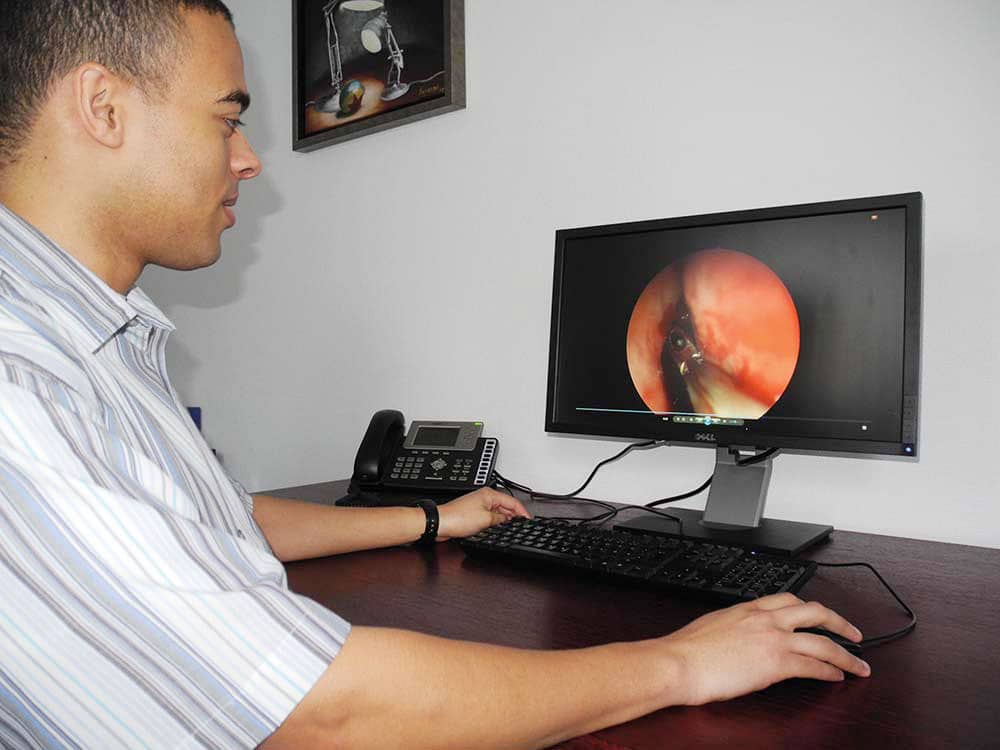
Digital post-processing can significantly improve video recordings of endoscopic examinations for medical evaluation (e.g. detection of anomalies) and assessment. A decisive step on the way to practical application, e.g. in gastrointestinal tract, lung and vascular endoscopy, is the so-called “glitter minimization”. This involves optimizing blurred video sequences as quickly as possible to enable real-time corrections by the surgeon
during the operation.
The basic idea of image stabilization of endoscopic images, which emerged as a spin-off from the joint project, has proven to be a sustainable approach. The project partners were the IRDC Leipzig and the Borstel Research Center. The methods developed were verified on extensive medical images so that the commercialization concept – patenting – could be put into practice. The main purpose of the project – the generation of scientific added value – was achieved with six publications. The findings were also made available in a scientific context at conferences and presentations in the Asia-Pacific region. The exchange of medical, endoscopic data was also discussed in talks, mostly with university hospitals in Medan (Indonesia), Kuala Lumpur (Malaysia), Singapore, Hanoi (Vietnam) and Dubai. The largest systematic collection of such data was again found at the Charité in Berlin.
The scientific results of the project were presented by the research team led by Dr. Markus Borschbachat the ELMAR (Electronics in Marine) congress in Zadar (Croatia), at the ICVGIP (Indian Conference on Computer Vision, Graphics and Image Processing) and at the associated MedImage workshop in Mumbai (India) as well as at the VISAPP (International Conference on Computer Vision Theory and Applications) in Lisbon.
Supported by